

- This event has passed.
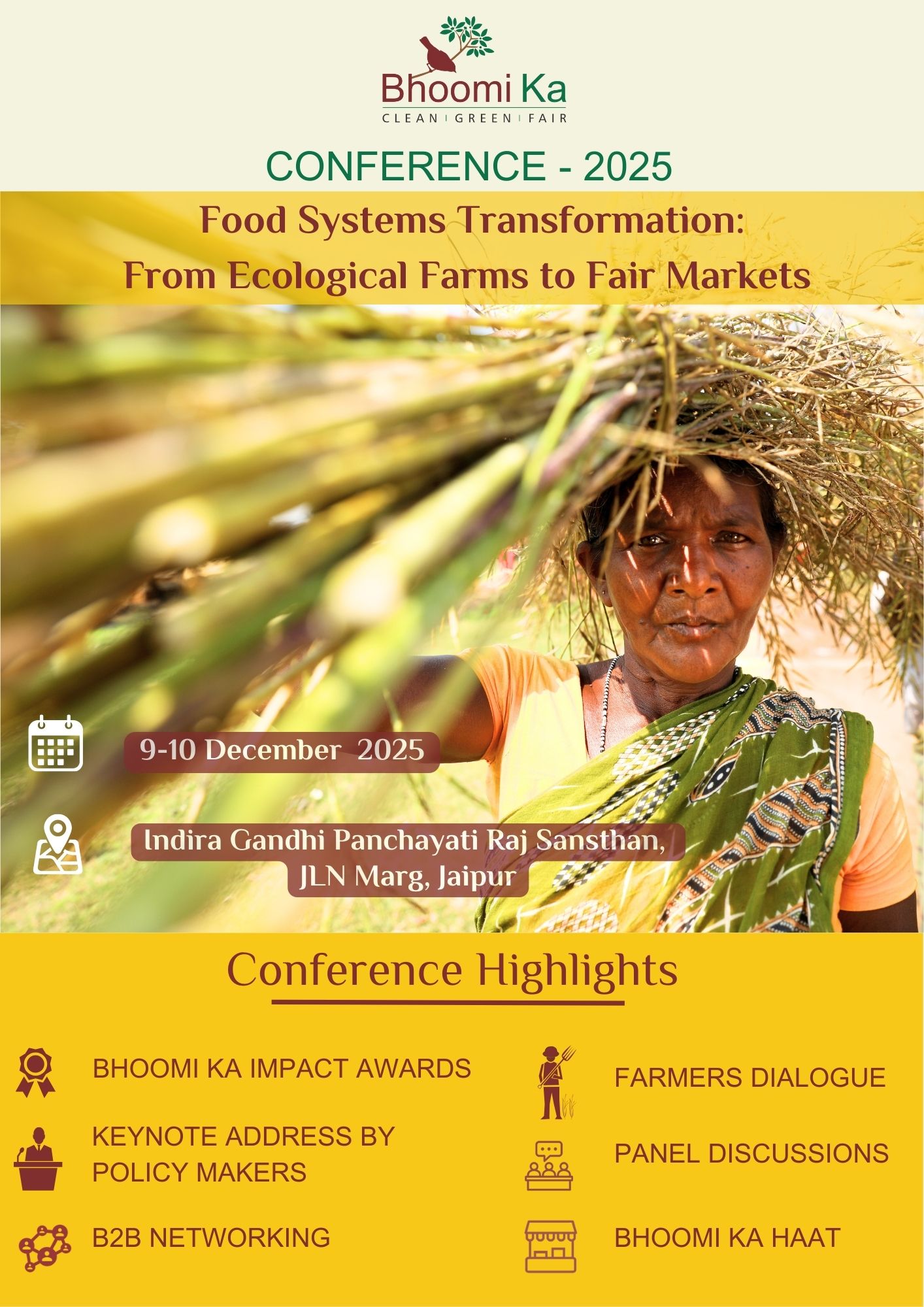
Bhoomi Ka’s Conference on Food Systems Transformation
December 9, 2025 @ 10:00 am - December 10, 2025 @ 5:00 pm
Context
The contemporary food system in India is facing pressing challenges as ecological degradation,
economic uncertainty, and social inequities converge. Intensive, monoculture-based agriculture has
placed a heavy burden on soil and water resources, resulting in declining soil fertility, falling water
tables, severe fertilizer and pesticide pollution, and the loss of indigenous crop diversity. At the same
time, small and marginal farmers struggle with crop loss and damage due to climate change, unstable
incomes, depletion of natural resources, and poor access to fair markets. These combined challenges
threaten both national food security and the livelihoods of millions of farmers.
A decisive transition toward sustainable and equitable food systems is the need of the hour. There is an
urgent call to move towards food systems that are Clean – environmentally sustainable, Green – climate
resilient and regenerative, and Fair – economically and socially just. Equally important is the
transformation of markets and value chains. Strengthening local food systems, farmer collectives, and
fair pricing mechanisms can reduce dependency on volatile markets and large corporate buyers, while
enhancing nutritional diversity and lowering environmental impacts, thereby strengthening Food and
Nutrition Swaraj.
To achieve this, it is paramount that government policies support an enabling ecosystem for
transformation—guided by community actions and grounded in research that fosters innovation,
promotes local knowledge, and strengthens Indigenous food systems.
The Bhoomi Ka Network plays a pivotal role in driving this transition. With over 10,000 farmers trained
in ecological practices, 5,000 certified through Participatory Guarantee Systems (PGS), and 52
ecological value chains supported, Bhoomi Ka has been at the forefront of food systems transformation.
Its growing network of 117 Farmer Producer Organizations (FPOs), 67 ecopreneurs, and several civil
society partners, experts, and academicians continues to promote Clean, Green, and Fair practices that
strengthen sustainable, smallholder-farmer–driven food systems. Yet, ecological farming remains far
from mainstream, and smallholder farmers still face limited access to markets, finance, and supportive
infrastructure.
VAAGDHARA with support of Bhoomi Ka is organizing convening a national conference to bring
together FPOs, SMEs, ecopreneurs, CSOs, experts, and policymakers to explore practical solutions for
scaling ecological farming practices and developing smallholder-friendly markets. The conference will
serve as a collaborative platform to share knowledge, strengthen partnerships, and co-create strategies
for sustainable growth. It will also facilitate policy dialogue and advocacy to create an enabling
environment for ecological agriculture, resilient value chains, and fair market systems. By bringing
together ecological FPOs, SMEs, ecopreneurs, civil society organizations, researchers, and government
representatives, the conference marks a vital step toward building a sustainable, equitable, and
regenerative food system that benefits farmers, communities, and ecosystems alike.
Key Objectives
1. Celebrate Bhoomi Ka’s Impact and Collective Achievements: Reflect on Bhoomi Ka’s journey
in promoting ecological agriculture, strengthening farmer institutions, and building sustainable
value chains that empower smallholders and ecopreneurs.
2. Strengthen Partnerships and Market Linkages: Facilitate collaboration among FPOs, SMEs,
ecopreneurs, CSOs, and ethical buyers through knowledge exchange, product showcasing, and B2B
interactions to deepen clean, green, and fair market relationships.
3. Scale Ecological Practices and Inclusive Value Chains: Develop strategies to expand ecological
farming and sustainable value chains by enabling smallholders to access fair pricing, diversify
markets, and build resilient, smallholder-driven enterprises.
4. Strategize for Future Growth and Market Opportunities: Explore emerging trends, policy
priorities, and innovations to chart Bhoomi Ka’s future roadmap—ensuring continued network
growth, sustainable markets, and long-term food system transformation.
Key Highlights
• Farmer Dialogues • B2B Networking
• Bhoomi Ka Impact Awards • Bhoomi Ka Haat
• Panel Discussions
• Keynote Address by Policy Makers
Participants
• Farmer Producer Organizations • Civil Society Organizations
(FPOs) and Ecopreneurs
• Government Agencies and Policy Makers • Agri-businesses and Social enterprises.
• Research universities and institutions
Expected Outcomes
1. Shared Vision and Roadmap: A collective roadmap developed for scaling ecological
agriculture, strengthening sustainable value chains, and advancing clean, green, and fair food
systems.
2. Market and Business Collaboration: Strengthened B2B linkages among FPOs, SMEs, and
ethical buyers—resulting in new business partnerships, trade leads, and product visibility within
and beyond the Bhoomi Ka network.
3. Policy and Advocacy Recommendations: Concrete policy inputs and actionable
recommendations to create an enabling environment for ecological farming, local value chains,
and smallholder-friendly markets.
4. Knowledge Exchange and Showcasing: Documentation and dissemination of best practices,
success stories, and innovative models—celebrating Bhoomi Ka’s impact and inspiring wider
adoption of sustainable food system approaches.